
Patterns in the Chaos: How Biblical Stories Speak in Echoes
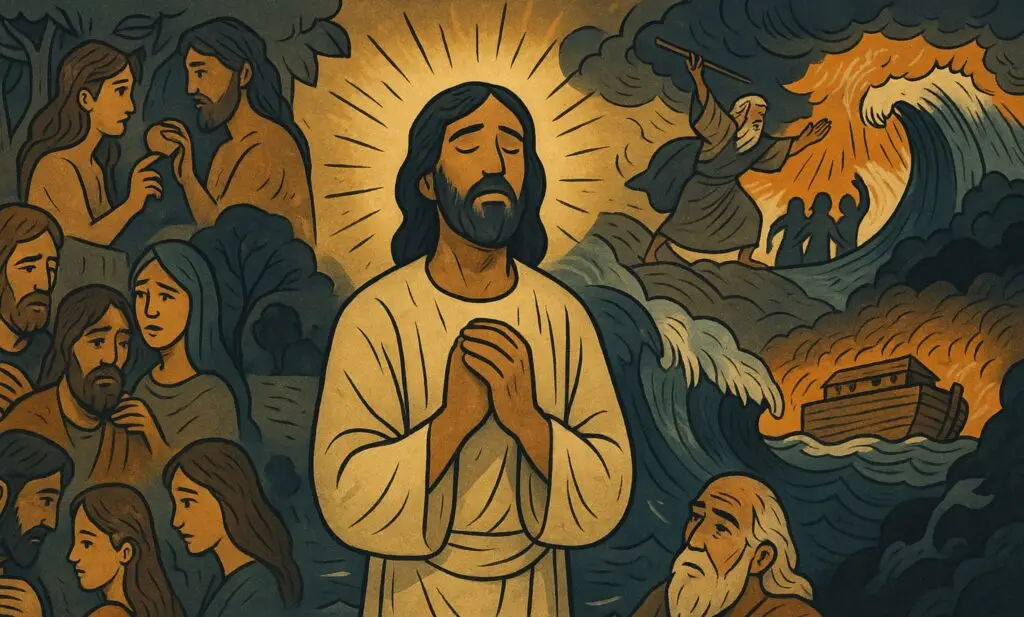
We often think of Bible stories as isolated Sunday school lessons (Adam and Eve, Noah’s Ark, David and Goliath, Jesus walking on water). But what if we’ve missed something? What if these stories are not just isolated historical accounts or moral fables, but deliberate, repeating patterns crafted by inspired authors?
Let’s explore how the Bible’s narratives aren’t just strung together but interwoven. The biblical authors embedded patterns (intentional echoes of words, images, and events) that help us see deeper theological themes unfold from Genesis to Jesus.
The Repeating Pattern of Human Failure
It starts in the Garden.
Adam and Eve (Human and Life) are created to rule in a good world. Repeated seven times in Genesis 1 is the declaration: “God saw that it was good.” Everything is good, good, good… until the humans begin to see something else.
We’re told they saw that the tree was good for food… they desired it… and they took it.
Sight. Desire. Taking. This is the seed of the fall. But the biblical authors didn’t leave this story behind. They used it as a template, a pattern that reappears again and again throughout Scripture.
- Abraham and Sarah see Hagar, desire a child, and take matters into their own hands.
- Aaron sees the gold, desires to appease the people, and takes it to make an idol.
- Achan sees the plunder, desires it, takes it, and his whole community suffers.
- Israel sees Saul, desires a king, and takes him, rejecting God’s rule.
- David sees Bathsheba, desires her, takes her, and then takes her husband’s life.
Each of these stories uses the same vocabulary and progression. And in each case, a moment of temptation leads to broader destruction. One person’s indulgence becomes everyone’s sorrow.
It’s a sobering pattern. But it’s not hopeless.
Jesus and the Broken Pattern
The pattern builds tension. It begs the question: Will anyone do it differently?
Enter Jesus.
In the garden of Gethsemane, he faces his moment of testing—not with fruit or gold or power, but with the cross. His prayer is simple: “Not my will, but yours be done.”
He sees the cost. He desires obedience. But unlike the others, he doesn’t take what isn’t his to grasp. He surrenders. And his surrender brings life instead of death.
Jesus doesn’t just break the pattern. He rewrites it. And in doing so, he invites us to live in a new way, to be the humans we were always meant to be.
Through the Waters to New Creation
Another major biblical pattern emerges around water and chaos.
On page one of the Bible, God brings order by separating chaotic waters to make dry land, a space where humans can flourish. That pattern repeats:
- Noah and his family are brought through floodwaters to dry land.
- Israel passes through the Red Sea, escaping slavery and entering new life.
- Joshua leads the people through the Jordan River into the Promised Land.
Each of these stories paints the same image, chaotic waters, divine deliverance, and the birth of something new. And they all point forward.
The prophets, especially Isaiah, began to hope for a new exodus, a day when God would again lead his people through chaos into new creation.
And that brings us again to Jesus.
Baptism and the Pattern of Resurrection
All four Gospels highlight the same event: Jesus goes into the waters of the Jordan and comes out again. His baptism echoes the ancient stories of deliverance, and God declares from heaven that Jesus is his Son.
That’s not just a one-time event. It’s a theological flashpoint. Jesus is stepping into the pattern (into the waters of chaos) and coming out the other side, ready to rescue the world.
This is why baptism matters. It isn’t just a ritual. It’s participation in that story.
It’s a symbolic death, going into the water as Jesus did.
And it’s a resurrection, emerging as part of a new creation.
Living in the Patterns
These repeated patterns aren’t accidental. They’re the Spirit-led artistry of Scripture. When we begin to see them, the Bible opens up. We no longer read it as scattered fragments but as a unified story, filled with deliberate echoes and hopeful tension.
- We see the recurring temptation, and the possibility of resistance.
- We trace the journey through chaos, and the hope of new life on the other side.
- And most importantly, we see how it all points to Jesus, the true Human who walks through fire and flood and comes out bearing resurrection.
The next time you read a biblical story, slow down. Listen for the echoes. Pay attention to the verbs. Watch what characters see, desire, and take. And ask: Have I seen this before?
You probably have.
And when you do, remember, this story, like all the others, leads to Christ.
Coming Next: Understanding the Poetry of Scripture
If biblical narrative is the story structure that frames the Bible’s message, poetry is its soundtrack. In our next post, we’ll explore the artistry, emotion, and spiritual formation that lives in biblical poetry, where the rhythm of the soul meets the Word of God.