
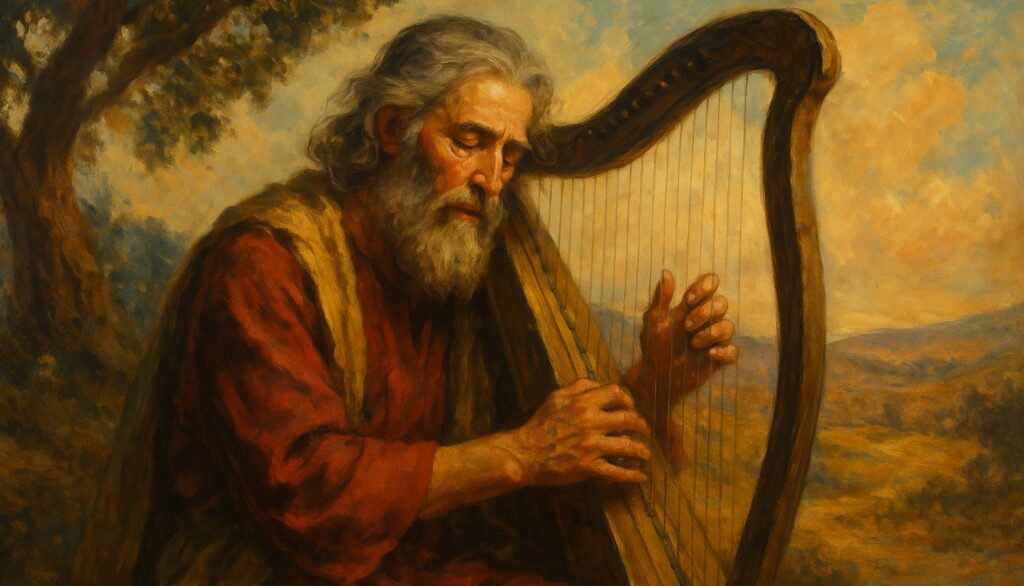
When the Story Sings: Learning to Read Biblical Poetry
So far in our journey through the Bible, we’ve focused on how to read its stories, narratives filled with characters, conflict, and resolution. But if you’ve spent any time in Scripture, you’ve probably noticed that sometimes, right in the middle of the action, someone starts singing. One minute Israel is walking through the Red Sea on dry ground, and the next, they’re belting out lyrics about God’s nostrils splitting oceans like Jell-O. What is going on?
That’s poetry.
And believe it or not, about one-third of the Bible is written in poetry. That means understanding the Bible isn’t just about reading the plot—it’s about learning to feel the patterns, see the images, and slow down long enough to hear the heartbeat behind the words.
Let’s talk about how.
The Power of the Pause
Think of the Exodus. First, the story tells us that “The waters were divided, and the Israelites walked through on dry ground.” That’s the historical moment. It’s straightforward, concrete, and clear.
But then comes the song: “By the blast of your nostrils, the waters piled up. The deep waters congealed in the heart of the sea.” Same event, radically different experience.
Poetry doesn’t just report what happened, it invites you into the moment. It’s not about information; it’s about immersion. God’s breath becomes a storm. Waters stack like walls. The imagination is ignited, and the reader is pulled out of the page and into the wonder.
This is why biblical narrative and poetry often stand side by side—because what stories describe, poems help us feel.
The Engine of Biblical Poetry: The Couplets
You won’t find much rhyming or rhythmic meter in Hebrew poetry like you would in Shakespeare or Dr. Seuss. Instead, biblical poetry works through parallel lines, two statements (called a couplet) placed side-by-side.
Here’s how it works:
- The first line makes a statement.
- The second line either:
- Completes the thought,
- Deepens it with metaphor or image, or
- Contrasts it to explore tension.
For example, Psalm 51 opens with:
“Have mercy on me, O God,
According to your steadfast love.”
Then follows with:
“According to your abundant mercy,
Blot out my transgressions.”
You’re not just reading facts. You’re being drawn deeper into the emotion, the desperation, the desire for restoration. The repetition is intentional, it slows the reader down. It says, Don’t rush past this. Savor it.
Like Diamonds: Multilayered and Multidimensional
Now imagine a handful of these couplets orbiting a single idea, each offering a new image or angle. That’s what biblical poets do.
Take Psalm 51 again. A few lines later, the poet describes sin as both internal (“I know my transgressions”) and external (“My sin is ever before me”). The poetic structure makes you stop and think, sin isn’t just something you do. It’s something you carry, something you feel, something that needs to be washed, blotted out, and cleansed.
It’s not abstract theology, it’s personal, painful, and beautifully human.
And that’s the point. The structure forces meditation. The poetry insists: stay here a little longer.
Patterns, Refrains, and Frames
Biblical poetry often includes refrains, lines that repeat throughout the poem to create emphasis or rhythm. Or inclusios, when the poem begins and ends with the same idea, acting like bookends.
These structures aren’t just artistic flourishes. They create thematic unity. They give a sense of completeness, like a melody returning to its first note. They help the reader trace meaning through form, not just content.
Why It Matters: The Purpose of Biblical Poetry
Poetry isn’t just about expressing emotions, it’s about forming the reader. Biblical poetry helps us develop:
- Wonder toward God’s creative power.
- Wisdom as we meditate on life’s tensions.
- Imagination as we picture invisible truths in concrete images.
More than that, biblical poetry trains us to read slowly in a fast world. To notice beauty in the mundane. To worship with our words. It shapes the affections, not just the intellect. And in doing so, it connects our story to God’s.
Don’t Master It—Dwell in It
Poetry in the Bible isn’t something to conquer. It’s a well that never runs dry.
You won’t always “get it” on the first read. And that’s okay. You’re not supposed to. Poetry is meant to form us over time. It rewards those who return to it. It reshapes us, slowly, with every rereading.
It’s meant to be lived with.
So let the stories sing. Let the poems shape your prayers. Let the couplets keep you up at night. And above all, let the Spirit use these ancient verses to soften your heart and sharpen your gaze.
Coming Soon…
Next up, we’ll explore the final tool of biblical poetry, how ancient authors used imagery and metaphor to pull our minds into the unseen world. Until then, maybe pull out a psalm, slow down, and read it out loud.
Let the Bible speak in the voice it was written in.
Let it sing.