
Metaphor and the Imagination of Scripture
When we crack open the Bible, we often come looking for direct answers, clear instructions, or literal truths. And the Bible certainly offers those, but sometimes it speaks in songs, riddles, and images that stir the imagination rather than lay out facts. That’s what poetry does. And it’s everywhere in the Bible.
In fact, more than a third of Scripture is poetry. That means we need to understand how biblical poetry works if we want to understand the Bible as a whole. And a key feature of that poetry is metaphor, those creative comparisons that help us see invisible realities through the lens of visible experiences.
We Think in Pictures
Whether we realize it or not, our minds are shaped by metaphors. Think about it, how do we talk about emotions?
“She gave me the cold shoulder.”
“He’s a warm person.”
“It took her a while to warm up to me.”
We’re not describing physical temperatures. We’re mapping something we understand (temperature) onto something abstract, emotion. Cold becomes a stand-in for distance, and warmth for affection. These aren’t just figures of speech, they’re tools of thought. We live by metaphor.
And so did the biblical writers.
Waves of Chaos, Mountains of Safety
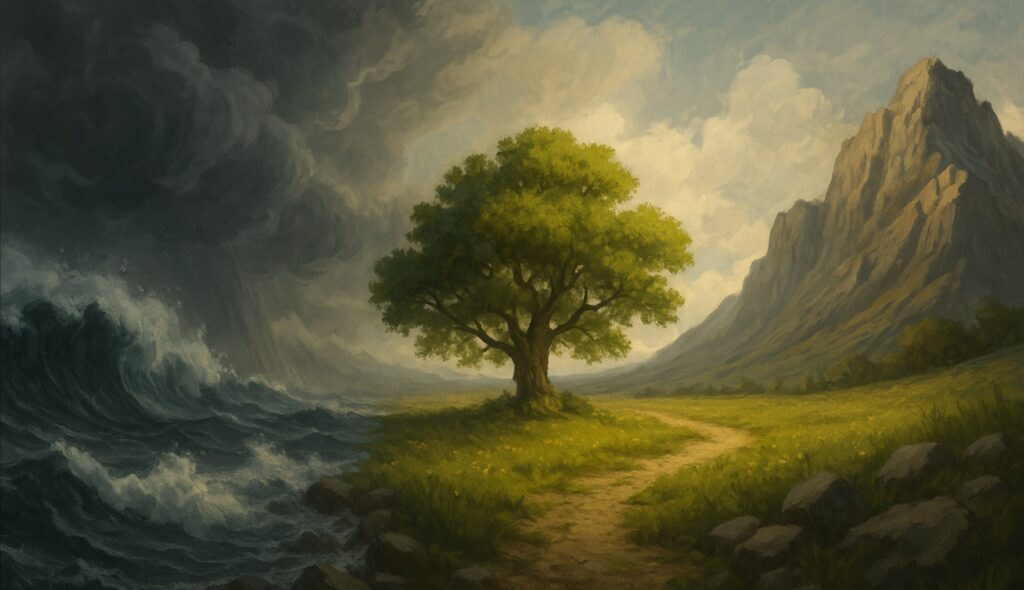
The world of the Bible is ancient, and its metaphors reflect that. One of the most powerful and recurring images in Scripture is that of chaotic water. Picture a stormy sea. Deep, dark, and unpredictable. For ancient people, most of whom couldn’t swim, this was a picture of danger, fear, and the threat of being overwhelmed.
Psalm 69 cries out, “The waters have come up to my neck.” But the psalmist isn’t literally drowning. He’s overwhelmed by enemies and fear. Water becomes a metaphor for the chaos of life. In Isaiah 17, raging nations are described as roaring seas. In Psalm 89, God’s power is pictured as one who rules over the swelling seas and scatters enemies with his arm.
This image goes all the way back to Genesis 1, where God brings order out of the formless waters. It’s a metaphor for God’s power to tame the chaos and bring stability. Which leads us to its opposite, dry land. In biblical poetry, dry ground represents safety, peace, and God’s provision. It’s where Eden is planted. It’s the place where the people stand when God parts the sea. It’s the place of rest.
Temple Streams and Garden Rocks
The poetry doesn’t stop there. In Psalm 65, David describes God’s presence in the temple as a stream that waters the land and stills the waves. Now we’re layering metaphors. The temple becomes the high place where safety is found. Water, which once symbolized chaos, becomes a gentle river of provision. And the temple itself becomes a symbol for God.
That’s why David can say in Psalm 18, “The Lord is my rock.” A rock is strong, stable, and unmoving. In a world of unpredictable waves and shifting sands, a rock is a place to stand. Jesus picks up this image when he says that those who hear and obey him are like people who build their house on the rock, on a foundation that won’t crumble when the storms come.
Reading with Imagination
If we want to understand biblical poetry, we have to think like ancient people. Not with modern literalism, but with imagination. The metaphors of the Bible aren’t random, they’re drawn from the stories that shape its world. To understand the Psalms, you need Genesis. To understand the prophets, you need Exodus. The images build on each other, telling a deeper story than facts alone can carry.
The Bible isn’t just informing us, it’s forming us. It’s inviting us into a way of seeing, where metaphor becomes a window into the divine. God is our rock. His love is a stream. His judgment is a storm. His presence is a garden. The poets of Scripture teach us how to see the world as God sees it, rich with meaning, alive with symbols, and lit up with eternal truths.
So, next time you open the Psalms or the prophets, slow down. Ask yourself, What picture is being painted here? What story is this image trying to tell? Because if we want to understand God’s Word, we need more than information, we need imagination.