
A Prayer Book for Exiles
If you spend much time in Scripture, you eventually meet a part of the Bible that speaks with a different voice. It doesn’t argue. It doesn’t explain. It sings. The biblical poets write with layers of meaning, weaving images and symbols that take time to notice. Their words are meant to be tasted, not rushed.
And nowhere is this more true than in the book of Psalms.
For many readers, the Psalms feel like a simple collection of prayers. A greatest-hits album. A spiritual playlist. You flip through and pick your favorites. But the Psalms are not organized like that. They were shaped carefully, poem by poem, placed in a specific order, telling a story from beginning to end.
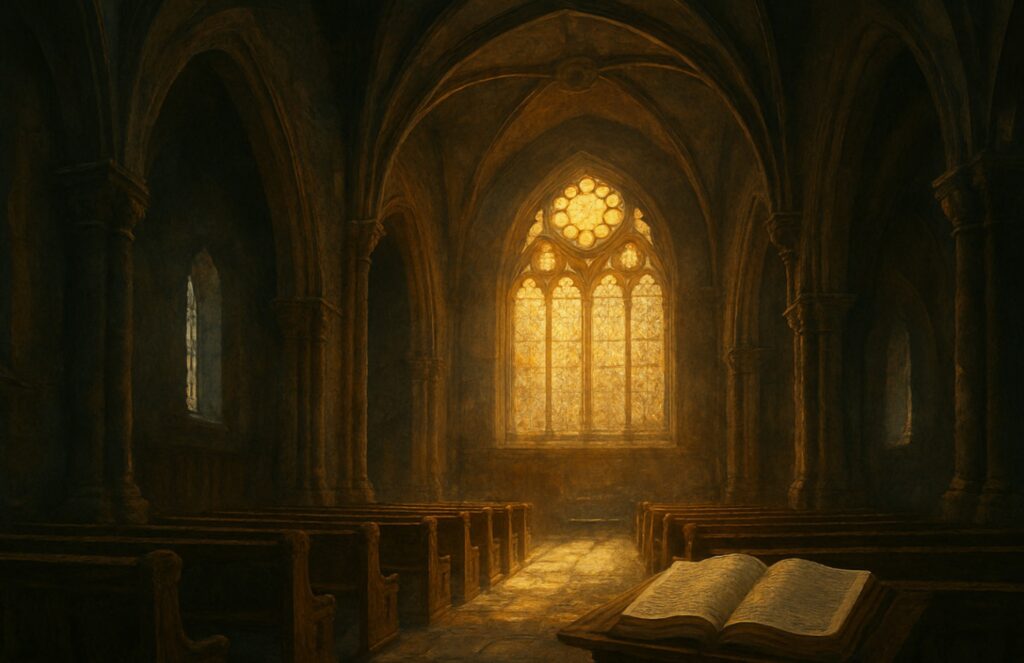
The Psalms are more like a cathedral built out of words. You step inside, and suddenly Scripture does more than inform you. It forms you.
A Place to Meet with God
In ancient Israel, people went to the temple to stand in God’s presence. Imagine stepping into that courtyard. You would see carved pillars and woven tapestries. You would smell incense rising like a prayer. You would hear choirs singing psalms that echoed off the stone walls.
Every part of that place told a story: God rules the world, God invites us close, and God is building a kingdom that restores broken people.
So what happens when the temple is gone?
What happens when God’s people are scattered and grieving, far from home?
That is when the Psalms become a gift. They function as a “portable temple,” a place you can enter no matter where you are. When life falls apart, when you feel like an outsider, when you wonder where God is, the Psalms create a sacred space in the middle of your ordinary world.
You step into them like someone stepping into quiet and remembering that you are not alone.
The Psalms Have a Shape
The book contains 150 poems divided into five distinct sections. And at the very front, before the songs even begin, two psalms act like open doors:
Psalm 1
It reaches back to the garden of Eden, where humanity walked with God beside a river of life. The psalm imagines a person who chooses God’s wisdom instead of their own definition of right and wrong. They become like a flourishing tree planted by that river. It is a picture of what humanity was meant to be.
Psalm 2
It looks forward. After humanity’s rebellion, God promised that a future king would come from the line of David. This king would be God’s Son, God’s chosen ruler, the one who brings justice and restores peace to the nations.
Psalm 1 and Psalm 2 together give you the themes of the whole book:
God’s wisdom, humanity’s calling, the brokenness of the world, and the hope for a king who will set things right.
Then the rest of the Psalms trace these themes like threads woven through five sections:
• The first two sections follow the rise and struggles of David and his royal line.
• The third section faces the devastation of Israel’s exile.
• The fourth and fifth sections rebuild hope for God’s Messiah and a new beginning beyond the ruins.
• The book ends with a five-part chorus of praise, celebrating God’s faithfulness.
This is not random. It is a story told through poetry.
David: A Coach for Prayer
Nearly half of the psalms are connected to David. If you read them, you find a man who knew the whole range of human emotion. One moment he is fearless. The next he is exhausted. He confesses sins that tear at his soul. He cries out for help. He marvels at God’s mercy.
And even though David lived before the temple was built, he longed to be near God with every fiber of his being. His words became a model for later generations who also felt far from home. Exiles could pick up David’s prayers and find their own voice in them.
Think of David like a prayer coach. He hands you the words you did not know how to say. His honesty becomes your honesty. His trust becomes your training ground. His hope becomes your anchor.
And many psalms written long after David followed the same pattern, ordinary believers learning how to talk with God by echoing the cries of those who walked before them.
A Book You Return to for a Lifetime
You do not read the Psalms once and close the cover. They are not meant to be conquered but lived with. They invite slow return, like a familiar path you walk again and again.
There are psalms for fear, for grief, for gratitude, for confusion, for repentance, for joy. There are psalms where people scream their questions into the night. There are psalms where people rest in God like children falling asleep in a safe place.
These poems were crafted for people who feel far from home, people who hunger for wisdom, people who are learning to trust that God’s kingdom is still coming even when the world looks broken.
In other words, the Psalms were written for people like us.
Learning to Enter the Psalms
When you open this book, treat it like stepping into sacred space.
• Let the poems slow you down.
• Let the images paint pictures in your mind.
• Let the honesty give you permission to be honest.
• Let the hope stir your own longing for the Messiah.
The Psalms are not just ancient songs. They are a training ground for the soul. A meeting place for God and his people. A home for those who feel like they have none.
Read them often. Read them slowly. Let them teach you how to breathe again.